
How PAGCOR Licensing Actually Differs From Curacao Licensing

PAGCOR is a Philippine state regulator that both licenses operators and runs its own casinos. Curacao’s Gaming Control Board (GCB), since November 2023, issues direct licenses without the old sub‑license middlemen. Neither system guarantees fairness or payouts on its own. The key difference for players lies in what each authority is equipped to check and how much of that checking is independent. You can verify some aspects of either license on your own. Other aspects require faith in the regulator’s judgment. Understanding which is which matters when evaluating a footer badge.

What PAGCOR licensing means in practice
PAGCOR (the Philippine Amusement and Gaming Corporation) derives its authority from Presidential Decree 1869 (1983), with its franchise extended to 11 July 2033 by Republic Act 9487 (2007). It is a government‑owned and controlled corporation that wears two hats. It regulates private gaming operators (audits, compliance monitoring, taxation). It also runs its own chain of Casino Filipino outlets and PAGCOR‑branded online products. That dual role is significant. It means the same body that writes the rules also competes in the same market as the operators it licenses.
What does getting a PAGCOR license involve? Operators must submit business plans, corporate documents, technical and system specifications, pay application and licensing fees, and then submit to ongoing compliance checks and taxation. That process is real. The documentation requirements are heavier than the Curacao sub‑license system ever was. The dual role creates a structural conflict. PAGCOR has an incentive to keep its own commercial properties competitive. This raises questions about how vigorously it polices its own licensees when they compete directly with its own products. The regulator is also a market participant in the same gaming ecosystem. Any player should understand this structural fact when verifying a footer badge that says “PAGCOR Licensed.”
A PAGCOR-licensed private online casino and PAGCOR’s own Casino Filipino online platform both target the same pool of Philippine players. If the private operator commits a minor compliance infraction, such as a delayed submission of a monthly return or a technical glitch in its responsible gambling tool that goes uncorrected for a few days, a purely independent regulator would issue a warning or a fine without hesitation. PAGCOR, as a commercial competitor, faces a structural disincentive. Aggressively penalizing its licensees for small infractions could drive players toward its own Casino Filipino products. Leniency keeps the licensed ecosystem intact and tax revenue flowing. The conflict is not about intentional corruption but about the natural tendency of any organization to avoid actions that benefit its direct competitors. This structural reasoning makes PAGCOR’s dual role a material consideration for any player assessing what the license badge actually guarantees.
PAGCOR licensing does not guarantee a specific RTP or payout speed. The operator has undergone formal vetting, is subject to taxation, and remains subject to periodic audits. This provides baseline oversight. It does not guarantee your wins or protect against unfavorable terms.
What a Curacao license means today (post‑reform)
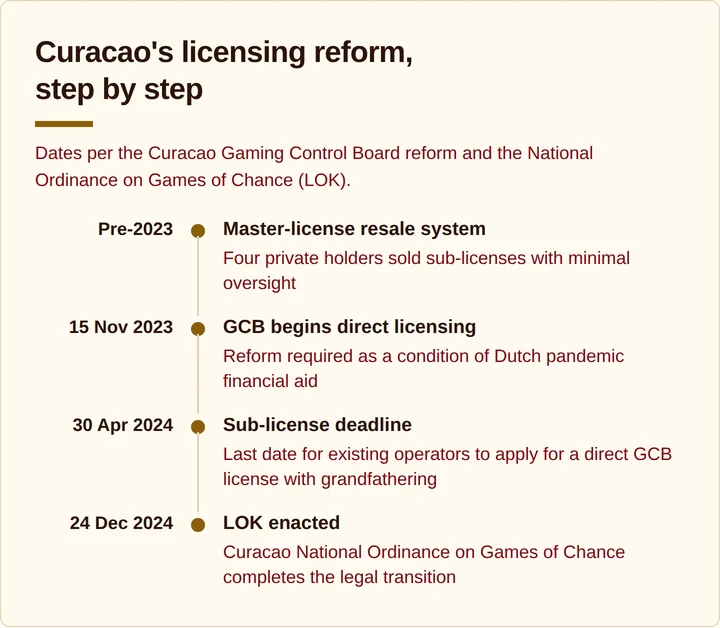
The phrase “Curacao eGaming license” is now dated. For years, Curacao operated a master‑license resale system. Four private companies (including the former Curacao eGaming, Antillephone, and Gaming Curacao) held “master licenses” from the island’s government and resold sub‑licenses to hundreds of operators with minimal oversight. The problem was structural. The master licensees made money by selling volume; vetting quality was never the incentive. An operator could get a sub‑license for a few thousand dollars, throw up a site, and start taking bets with almost no background check. That’s why “Curacao license” earned a reputation as easy to get and hard to hold accountable.
That changed on 15 November 2023. The Dutch government, which had provided pandemic financial aid to Curacao, made reform a condition. Curacao had to move to a direct‑licensing system overseen by a single independent regulator, the Gaming Control Board (GCB). The GCB now issues online gaming licenses directly, bypassing the four master holders. Existing sub‑license operators had until 30 April 2024 to apply for a new direct GCB license with grandfathering benefits. The legal transition was completed when the Curacao National Ordinance on Games of Chance (LOK) was enacted on 24 December of that same year.
Operators who applied before the April deadline kept operating under their existing sub-license while the GCB processed their new one, so there was no gap in legal authorization. Operators that missed the deadline had no such bridge. The old master-license/sub-license resale structure had stopped accepting new applications, leaving no valid path back into the previous framework.
Today, “Curacao licensed” means the operator holds a license from the GCB. Not all operators who still claim “Curacao eGaming” in their footers have made the transition. A player cannot assume the old phrase means the new reality. The GCB maintains a public register where you can look up license numbers, but not every site updates its footer badge promptly.
Side‑by‑side comparison
PAGCOR and the Curacao GCB differ on five structural points, covering who issues the license, whether the regulator also competes commercially, how oversight is organized, how a player checks a license number, and how each handled offshore licensing.
| Aspect | PAGCOR | Curacao GCB |
|---|---|---|
| Issuing authority | Government corporation, Philippine state-owned | Government agency (GCB), Curacao finance‑related |
| Regulator also operates? | Yes, runs Casino Filipino and own products | No, only regulates, no commercial operations |
| Oversight structure | Centralized under one entity with dual role | Direct licensing by GCB since 2023, no sub‑license tier |
| License number check | PAGCOR publishes list of accredited operators on its website | GCB maintains a public register of direct licensees |
| POGO offshore licensing | Ended 31 Dec 2024 per EO 74 (Nov 2024) | Not relevant, Curacao licenses are for its own jurisdiction |
The biggest gap in the table is the second row. PAGCOR both regulates and competes; the GCB’s role stays limited to regulation. That single structural fact explains most of the other rows.
Philippine President Marcos signed Executive Order 74 in November 2024, banning all Philippine Offshore Gaming Operators (POGO) and Internet Gaming Licensees. All such licenses expired by year-end, ending PAGCOR’s offshore‑category licensing. The domestic licensing discussed here is unaffected. No new POGO licenses are being issued.
What this means for a player checking a footer license badge
When you see a “PAGCOR Licensed” badge on a casino site, you can verify it by checking PAGCOR’s own published list of accredited operators. The license number on the site should match an entry on that list. If it doesn’t, the badge is fake, a red flag. Similarly, if a site says “Curacao eGaming License,” you should now look for a GCB license number and check the GCB register. If the site still uses the old phrase without a GCB number, it may not have transitioned, which means the oversight it claims may not exist.

A valid license number verifies regulatory vetting. It confirms the regulator has reviewed the operator. PAGCOR audits compliance with local laws and tax rules. Game fairness audits happen separately, if at all. The Curacao GCB requires operators to submit to technical standards, but enforcement is still young. Most footer badges skip the distinction between “licensed” and “independently verified fair.”
You can verify three facts from outside. First, whether the license number is real. Second, whether the regulator has a public registry. Third, whether the regulator has enforcement actions on record. The claim that an operator “operates under the strict supervision of…” is marketing copy. It does not appear in verifiable registries.
Why review sites blur these two licenses together
Walk into any casino review aggregator and you’ll see “PAGCOR” and “Curacao” treated as interchangeable trust badges. The reason is commercial convenience. Both are government‑issued licenses, both appear in footers, and both are cheap to list as bullet points. The structural differences (PAGCOR’s dual‑role conflict, Curacao’s old sub‑license free‑for‑all, the reform timeline) are harder to explain in a 100‑word pros‑and‑cons table.
Those differences matter. A Curacao license issued before that year was effectively a rubber stamp from a private reseller. A PAGCOR license comes with more rigorous application requirements. The regulator is also a market competitor. These licenses differ fundamentally. Treating them as equivalent misleads players into thinking that any government badge ensures the same oversight. A misled player might assume a Curacao badge offers the same protections as a PAGCOR badge, or vice versa, and choose a site based on false equivalence.
The takeaway: a license badge names a regulator. The real question is how that regulator operates. A license is only as good as the system behind it.
Responsible gambling
All gambling involves risk of loss. No license, whether from PAGCOR or the Curacao GCB, guarantees that you will win or that you can afford to lose. Philippine law requires operators to promote responsible gambling. Set deposit limits, take breaks, and never chase losses. If gambling stops being fun, seek help from the responsible gambling resources listed on our responsible gambling page. This site is intended for players aged 18 and over. For more detail on how licensing structures affect player protections, see our licensing and regulation guide.
FAQ
Is the Curacao eGaming license still a thing?
The old system no longer exists. The Curacao eGaming brand was one of the four master license holders selling sub‑licenses until the reform. That system has been replaced by direct licensing from the Gaming Control Board. Some operators still display “Curacao eGaming” in their footers. That phrase now refers to a defunct framework. If you see it, check for a GCB license number to confirm the operator has transitioned.
Does PAGCOR licensing apply to offshore sites?
Not anymore. PAGCOR issued offshore gaming licenses under the POGO category until year-end. Those licenses are now banned by Executive Order 74. PAGCOR today only licenses operators that serve the Philippine domestic market, including those that run online platforms for Philippine residents. A site claiming “PAGCOR license” for offshore players may be using an expired or misleading badge.
Can a Curacao‑licensed casino serve Philippine players?
It can try. Philippine law prohibits offshore operators from targeting Philippine residents without a valid PAGCOR domestic license. In practice, many Curacao‑licensed sites accept Philippine players. They operate in a legal grey area. The Philippine government has not actively pursued individual players. The operator faces risk of enforcement action. Always check local regulations.
How do I check a license number myself?
For PAGCOR, visit the official PAGCOR website and look for the list of accredited operators. Enter the license number displayed on the casino site. If it matches, the license is valid. For Curacao GCB, the GCB publishes a public register of direct licensees. Search by the company name or license number. If the number doesn’t appear, the operator may not have transitioned or may be using a bogus claim.
Which license is stricter?
Paperwork and independence point to different regulators. PAGCOR wins on documentation, since its application process demands more corporate, technical, and financial detail up front. The Curacao GCB wins on independence, since it has no commercial stake in the market it oversees. Neither edge translates into a fairness guarantee. Independent game testing still matters regardless of which badge is on the footer.
What happened to POGO licenses under Curacao?
The POGO ban ended all Philippine offshore licenses. Curacao itself does not issue POGO licenses; it issues its own jurisdiction’s licenses. The confusion arises because some POGO operators also held Curacao licenses. Those Curacao licenses remain valid if the operator has transitioned to GCB. None of them allow the operator to legally serve the Philippine market from Curacao. The two systems are separate.
Does a license guarantee fairness or payouts?
No. A license confirms regulatory vetting. It does not verify that every game is fair, that RTP percentages are accurate, or that withdrawals will be processed promptly. Independent audits (eCOGRA, iTech Labs) operate separately from licensing. A licensed casino may still have unfair terms or slow payouts. Always read the terms, check player forums for real experiences, and verify independently without relying solely on a license badge.
This article is for informational purposes only and does not constitute legal advice. Gambling involves risk. Always play responsibly and within your means. Check your local laws before playing. 18+ only.